
Why Does Something Always Come Up?
If you’re a mom, you know how quickly family expenses can add up. New shoes because someone outgrew theirs overnight, sports fees, school expenses, and a friend who wants to meet up for coffee.
Then there are the expenses that come at certain times of each year. Christmas happens every December. Birthdays come every year. Summer brings vacations, activities, and plenty of extra fun.
The truth is, some seasons simply cost more than others. And while we can’t plan for every unexpected expense, we can prepare for many of them.
That’s where Sinking Funds come in.
Sinking funds allow you to set aside a little money at a time for expenses you know are coming, so when it’s time to spend the money, it’s already there waiting for you.
Sinking funds are how we turn those “Oh no, I forgot about that!” expenses into things we’ve already planned for.
Sinking funds work best when they’re part of a bigger plan for your money. If you haven’t created a monthly budget yet—or yours never seems to work quite the way you hoped—start with my guide on How to Create a Family Budget That Actually Works. Then come back here and we’ll tackle those bigger expenses together.
What Is a Sinking Fund?
A Sinking Fund is money you set aside a little at a time for a specific future expense.
Let’s look at Christmas for an example:
Christmas goal: $1200
12 months to save
$1,200 ÷ 12 = $100/month
Instead of suddenly needing an extra $1,200 in December, you’re putting away $100 each month.

Sinking Fund vs. Emergency Fund
Sinking Funds and Emergency Funds are both important parts of a family budget, but they have very different purposes.
Sinking fund: This is money you intentionally set aside over time for expenses you know are coming. The goal is to actually use this money when the planned expense arrives—whether that’s Christmas, a family vacation, new tires, or kids’ activities. Then you can start building the fund back up for the next expense.
Emergency fund: This money is meant for the things you couldn’t plan for. You build your emergency fund to a comfortable amount and then leave it alone unless a true financial emergency comes up, such as a major unexpected repair, medical expense, or loss of income. A common goal is to eventually have enough saved to cover about three to six months of your family’s essential expenses.
An easy way to remember the difference is this: If you know the expense is coming, save for it in a sinking fund. If you couldn’t reasonably see it coming, that’s what your emergency fund is for.
Examples:
Christmas → Sinking Fund
New tires you’ll need next year → Sinking Fund
Unexpected job loss → Emergency Fund
Nice takeaway:
If you can reasonably predict it, it probably belongs in your Budget or a Sinking Fund—not your Emergency Fund.
Why Sinking Funds Work So Well for Families
Family spending isn’t perfectly even from month to month. In our family, I know that I spend more during the summer when we’re taking trips, keeping the kids busy, and enjoying more time together.
December is another expensive month—not only because of Christmas gifts, but because of parties, special meals, eating out, and all the little extras that come with the season.
Most of those expenses I’ve come to expect. I know summer comes every year. I know Christmas is in December. Sinking funds let me plan for those seasons ahead of time instead of wondering how we’re going to fit everything into one month’s budget.
Sinking funds can help you:
- Avoid putting predictable expenses on a credit card
- Keep one expensive month from wrecking the budget
- Spend money without guilt because you’ve already planned for it
- Prepare for fun things, not just bills
- Reduce financial stress
- Be more intentional about what your family values
For me, this is also part of being a good steward of what God has given us. Planning ahead doesn’t mean we can predict or control everything that will happen. It simply means we’re trying to use our money wisely and thoughtfully.
I don’t want our budget to come from a place of fear where we’re afraid to spend money or enjoy the things we’ve worked and saved for. I want it to help us make intentional choices, prepare for what’s ahead, and be content with what we have.
That’s one of the things I love about Sinking Funds. They give us permission to enjoy the money we’ve purposely set aside, because we’ve already decided that expense is important to our family.
15 Sinking Fund Categories for Families
Here are some possible Sinking Fund categories for families that you may wish to save for. You probably don’t need all 15 yourself. Just choose the categories that apply to your family’s needs.
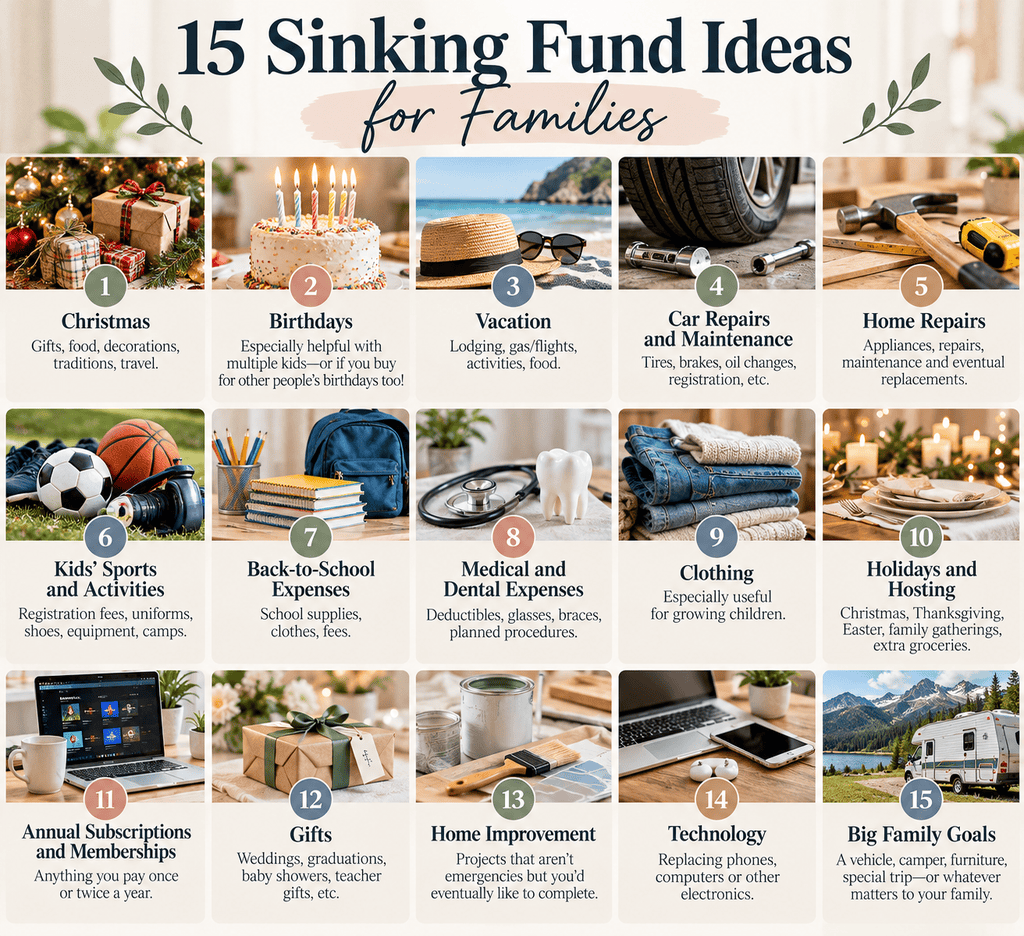
1. Christmas
Gifts, food, decorations, traditions, travel.
2. Birthdays
Especially helpful with multiple kids—or if you buy for other people’s birthdays too!
3. Vacation
Lodging, gas/flights, activities, food.
4. Car Repairs and Maintenance
Tires, brakes, oil changes, registration, etc.
5. Home Repairs
Appliances, repairs, maintenance and eventual replacements.
6. Kids’ Sports and Activities
Registration fees, uniforms, shoes, equipment, camps.
7. Back-to-School Expenses
School supplies, clothes, fees.
8. Medical and Dental Expenses
Deductibles, glasses, braces, planned procedures.
9. Clothing
Especially useful for growing children.
10. Holidays and Hosting
Christmas, Thanksgiving, Easter, family gatherings, extra groceries.
11. Annual Subscriptions and Memberships
Anything you pay once or twice a year.
12. Gifts
Weddings, graduations, baby showers, teacher gifts, etc.
13. Home Improvement
Projects that aren’t emergencies but you’d eventually like to complete.
14. Technology
Replacing phones, computers or other electronics.
15. Big Family Goals
A vehicle, camper, furniture, special trip—or whatever matters to your family.
How Many Sinking Funds Should You Have?
I don’t recommend starting with 15 Sinking Funds. I’d recommend starting with 3–5.
Too many sinking funds can make budgeting feel unnecessarily complicated.
Ask yourself: What expenses repeatedly catch you off guard? Those should probably be the first sinking funds you create.
For example:
| Sinking Fund | Goal | Monthly Amount |
|---|---|---|
| Christmas | $1,200 | $100 |
| Vacation | $2,400 | $200 |
| Car Repairs | $1,200 | $100 |
| Kids’ Activities | $600 | $50 |
| Home Repairs | $1,200 | $100 |
Total: $550/month
You Don’t Need to Fund Everything at Once
After looking at a long list of sinking fund ideas, it can be tempting to think you need to start saving for every single one. You don’t!
Start by looking at your family’s biggest needs and the expenses that tend to throw off your budget the most. Maybe Christmas always sneaks up on you, your kids’ sports fees seem to hit all at once, or you know your car is going to need new tires soon. Start there.
If you only have an extra $100 or $200 each month to put toward sinking funds, decide which expenses are most important and fund those first. You can always add more categories later as your budget allows.
Remember, the goal isn’t to have a perfectly funded Sinking Fund for every possible expense. The goal is simply to be a little more prepared than you were before. Even setting aside a small amount each month can make a big expense much easier to handle when it arrives.
How to Start a Sinking Fund in 5 Simple Steps
Step 1: Decide what you’re saving for
Pick one specific expense.
Step 2: Estimate how much you’ll need
It doesn’t have to be perfect, just an estimate.
Step 3: Decide when you’ll need the money
Christmas might be December. Vacation might be June. Car maintenance may simply be ongoing.
Step 4: Divide the amount by the number of months
Family vacation: $3,000
10 months away: $3,000 ÷ 10 = $300/month

Step 5: Add it to your monthly budget
This is the key.
Don’t just hope you’ll save $300. Treat the sinking fund like another monthly expense.
Where Should You Keep Sinking Funds?
You have a few options:
- A savings account and then track the individual categories in a spreadsheet
- Cash envelopes
- A HYSA (High Yield Savings Account) where you can create categories or “Buckets” for each of your Sinking Funds all in one account. This is my favorite option because they have a higher interest rate payout.
I personally have an Ally Bank HYSA. It currently pays me an interest rate of 3.05%, which is MUCH better than my traditional local bank savings account interest rate of .04%.
What If You Can’t Afford All Your Sinking Funds?
You don’t have to fund everything immediately.
Prioritize:
1. Necessary + coming soon
2. Necessary + farther away
3. Optional/fun expenses
And don’t forget:
Saving $25 a month toward a $600 expense is still better than saving nothing because you couldn’t afford the “perfect” amount.
If the expense arrives before the fund is fully funded, you’ve still reduced the amount that has to come from that month’s budget.
Sinking Funds Don’t Have to Make Your Budget Complicated
Budgeting isn’t about tracking 47 categories and controlling every penny.
It’s about telling your money where you want it to go before it disappears somewhere else. Sinking funds simply help today’s income pay for tomorrow’s priorities.
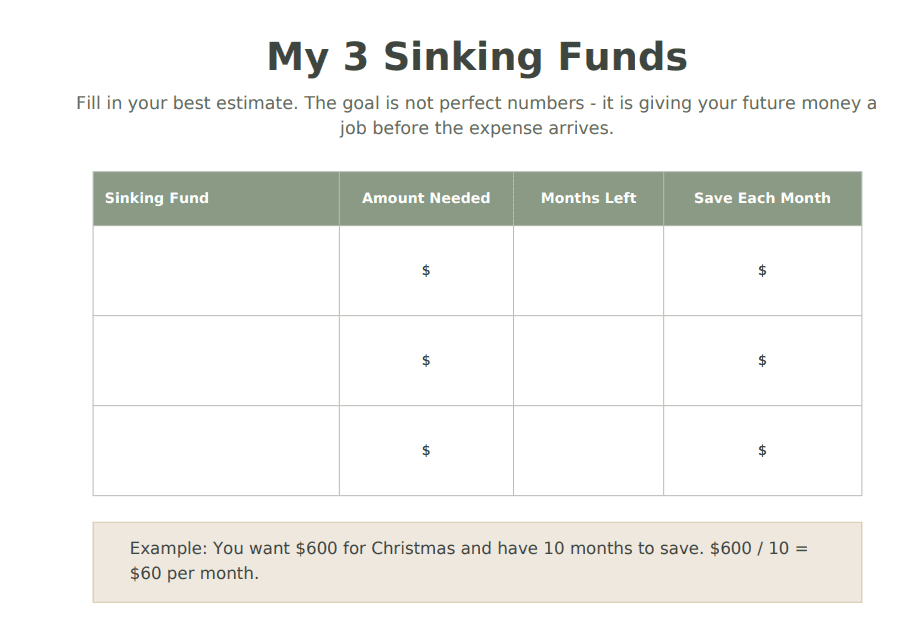
A Simple Sinking Fund Challenge
This week:
- Think about the next 12 months.
- Write down 5 options for Sinking Fund expenses you know are coming.
- Pick the 3 most important.
- Estimate how much you’ll need.
- Divide each amount by the months remaining.
- Add those amounts to next month’s budget.
That’s it. You officially have sinking funds.
Want help getting started? Download this FREE “Simple Sinking Fund Challenge” worksheet.
And don’t forget to check out this post: How to Create a Family Budget That Actually Works for anyone who needs help building the overall budget.